Russian missiles hit Poland: What happened, and could NATO respond?
Security cameras captured the moment a suspected Russian missile struck Polish territory during an attack on Ukraine on Friday. Poland’s government says it may have been hit by two missiles and a jet-powered drone.
Full article
The incident, which took place as European troops held military drills in the country and as the United States pushes to revive talks on ending the war in Ukraine, have raised questions about whether the strike was deliberate.
So what happened, and does this mean Russia has struck Poland, a NATO member?
Poland’s Defence Minister Wladyslaw Kosiniak-Kamysz told a news conference in Warsaw that two missiles and a jet-powered drone fell on Polish territory during Russia’s overnight attack on November 20. The missiles came down at Nowy Lipowiec and Rudnik nad Sanem, while the jet-powered drone fell at Molodycz, all in the country’s southeast.
One missile is believed to have crashed about 35km (22 miles) from where European troops’ military exercises were taking place. A Kh-101 cruise missile went down about 50km (31 miles) from the Ukrainian border, and what officials believe was a jet-powered drone hit about 30km (20 miles) from the border. No immediate injuries or damage were reported.
That night, Russia launched one of its heaviest bombardments of Ukraine. Ukrainian President Volodymyr Zelenskyy said Russia fired more than 400 drones and at least 110 missiles, including 27 ballistic missiles, some with cluster warheads. At least eight civilians were killed and more than two dozen were wounded.
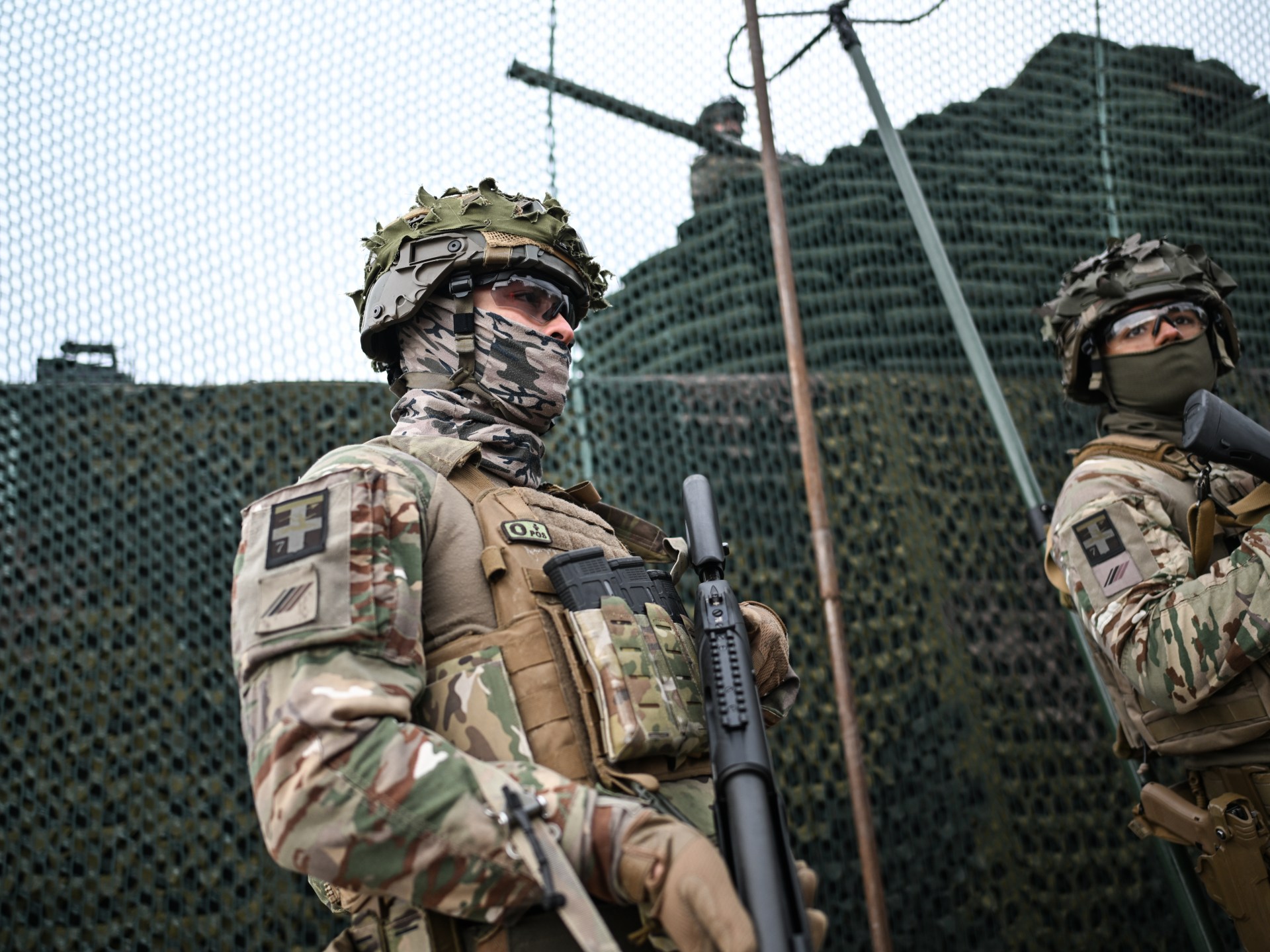
Polish Prime Minister Donald Tusk said it appeared “we are dealing with an intentional provocation” by Russia. He said the incident was likely timed to coincide with the European military exercises in Poland. The unprecedented two-week exercise began on November 9 in southeastern Poland and is preparing forces for a possible post-war mission in Ukraine to help stabilise the country and rebuild its military.
“A few months ago, it was flying the drones into airspace , and indeed a couple of times they flew fighter jets across the border into the Baltic states,” he said. “You just test how NATO responds.”
This time, he said, Moscow had “gone a bit further”. “You lob a couple of missiles across and a drone” near where 11 countries are holding exercises.
The Polish Air Force had launched preventive air patrols on September 17 aimed at securing the eastern part of Polish airspace following repeated incursions in the previous weeks.
Harry Nedelcu, partner and senior director for geopolitics at Rasmussen Global, said the testing has not been limited to Poland.
He linked the incursions to one of Moscow’s core war aims. “One of the key goals in Ukraine that Russia has had in the full-scale invasion, that has lasted almost five years now, has been to prevent Ukraine from being a part of NATO,” he said. “So their goal clearly is to undermine NATO, to do everything possible to undermine it.
“What Russia is doing with these missiles, drones, that sometimes find their way into NATO territory, tests NATO just under the radar of Article 5 to see how far can they push things. How far can they take hybrid warfare?”
Under Article 5 , each member of the NATO alliance understands that if one of them is the “victim of an armed attack, each and every other member of the alliance will consider this act of violence as an armed attack against all members”.
At a meeting on Thursday with European leaders in Germany’s capital, Berlin, US President Donald Trump’s envoy and son-in-law Jared Kushner said he believes Russia would be “comfortable” with NATO-like security guarantees for post-war Ukraine.
Kushner and fellow special envoy Steve Witkoff have been holding talks with Ukraine and Russia in recent days, in a push for peace which has been viewed as sidelining Ukraine’s European allies.
Following the Berlin meeting, French President Emmanuel Macron said Ukraine’s membership of NATO should be considered again, prompting Russian Deputy Foreign Minister Sergey Ryabkov to push back.
Ryabkov said any form of “quasi membership” for Kyiv of the Western military alliance was totally unacceptable for Moscow, Russian state media reported.
Lucas said the timing of the missile incursion into Polish territory now is very likely tied to the ongoing US-led peace talks.
“The Russians cannot be seen to go through talks and completely exclude Europe,” he said. He described the Kremlin’s push for a “Europe-wide security architecture” as a way to avoid discussing a ceasefire or security guarantees for Ukraine.
“Rather than having a strong Europe at the talks, they want to try to divide Europe, they want to try to unsettle Europe, they want to try to scare Europe,” he said.
He also pointed to Ukraine’s recent strikes on the Kerch Bridge , which links occupied Crimea to Russia. He said these were seen as “a very serious attack on Russian capabilities” with “severe political, military and economic consequences”.
The latest Russian bombardment follows President Vladimir Putin’s pledge to retaliate against those strikes.
NATO Secretary-General Mark Rutte called the missile incident a “grave violation” of Poland’s airspace. On X, he said the incident was “clearly dangerous” and a consequence of Russia’s ongoing war against Ukraine. Rutte is expected to visit Poland this weekend.
UK Prime Minister Andy Burnham called it “utterly unacceptable”. Germany’s Foreign Ministry called it “yet another example of Russia’s ongoing provocations”.
US President Donald Trump had played down earlier incursions hours before. “Putin has been landing drones in Poland and a couple of little missiles, by mistake,” he said.
Nedelcu said Warsaw’s reaction was “definitely a strong one”, with Polish officials “drawing a parallel between the fact that actually around the same time there were exercises by the Coalition of the Willing [those countries willing to provide support to Ukraine] nearby, and that this may have not been a coincidence”.
He said Poland is now “asking for more NATO support under this Eastern Sentry mission that already exists”.
“It’s not if, but what form that additional support will take – maybe an airborne early warning aircraft, or something of the sort,” he said.
“But what they have stopped short of is invoking Article 4,” he added, referring to the clause under which allies consult each other before invoking Article 5. “It’s unclear whether this was at their own volition. Maybe perhaps allies don’t want to use it too often, because Article 4 is also quite serious. It has been invoked not often, and it loses its value if it’s constantly invoked.”
Lucas said the public condemnation from European leaders was itself the message to Moscow. “It’s a signal to the Russians: look, we know what you’re doing, we see what you’re doing here,” he said.
“But you’re not going to run it up into an all-out military confrontation over a couple of missiles.”
He said he expects the response to be “defensive”, built on “preparedness” of ground forces, air, naval and cyber-defence, and defence against disinformation. “These will be the most intense preparations you will have had, certainly since the 1980s and possibly well before that,” he said.