Cầu Kerch quý giá của Nga trúng đòn trong cuộc tấn công bằng máy bay không người lái của Ukraine (Đã cập nhật)
Cầu Kerch, một trong những cơ sở hạ tầng có tầm quan trọng chiến lược lớn nhất và được phòng thủ cẩn mật nhất của Nga, bắc qua eo biển Kerch giữa vùng Krasnodar ở Nga và bán đảo Kerch của Crimea, đã bị tấn công...
Nội dung chi tiết
The Kerch Bridge, one of Russia’s most strategically important and heavily defended pieces of infrastructure, spanning the Kerch Strait between Krasnodar Krai in Russia and the Kerch Peninsula of Crimea, has been struck again. The latest attacks came amid a massive Ukrainian overnight offensive that Moscow says involved 1,336 long-range drones.
Update: The Russian-installed head of Crimea, Sergey Aksyonov reported a second attack on the bridge in less than 24 hours.
The Russian-installed head of occupied Crimea, Sergey Aksyonov, confirmed that the crossing, which includes both automotive and rail lanes, had been targeted earlier today, announcing temporary traffic restrictions while authorities assessed the situation.
The attack reportedly occurred at approximately 5:38 a.m. local time, with a Ukrainian one-way attack drone striking one of the bridge’s arches. Russian air defenses were reportedly engaging incoming drones around the structure.
Video purportedly showing the moment of the attack includes the appearance of a straight-winged, propeller-driven drone with the twin booms and inverted-V tail that is a feature of several different Ukrainian strike drones.
The extent of the damage remains unclear, but there are now very visible signs of the main road span on the Kerch side of the bridge having been hit.
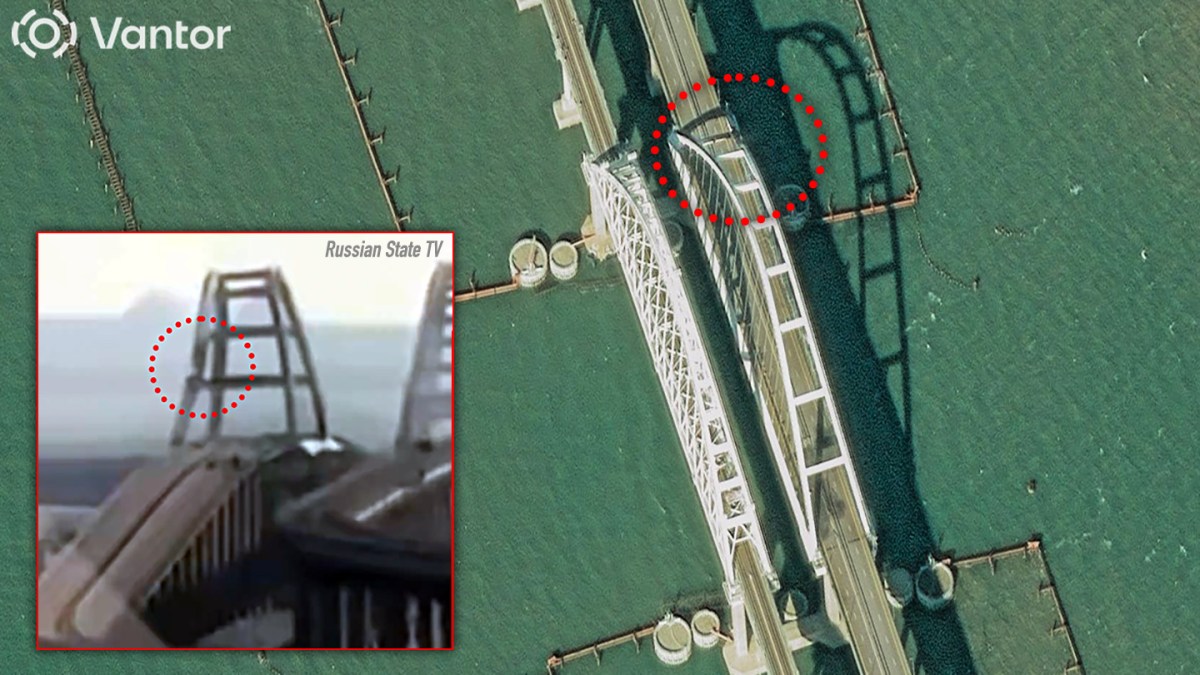
Footage broadcast on Russian television first showed the significant damage to the crossing. The main road span looks to have sustained a direct hit to its superstructure, with visible deformation of the structure. Reportedly, the original footage was subsequently removed by the Russian broadcaster.
One early report suggested that the affected arch was leaning at an approximately 15-degree angle. While certainly leaning, the precise angle has not been independently verified.
Meanwhile, satellite imagery confirms signs of damage to the bridge following the overnight attack, including around the arch of the road crossing, consistent with what we can see in the Russian television report. The imagery also appears to show dark marks, possibly scorch marks, at the opposite end of the main road span, although these may not be related to the latest attack.
Any kind of damage to the arch is noteworthy given the importance of the bridge’s supporting structure, although it is not yet possible to determine to what degree the structural elements impacted have been compromised.
Russian authorities were quick to indicate that traffic would resume following an inspection; the crossing remained closed long into the day. However, by the afternoon, Russian media were reporting that the bridge had reopened, albeit only in one direction at a time, although accompanying video footage appeared to deliberately avoid showing the damaged arch, and vehicles moving across the bridge were also absent from the available clip.
Kremlin spokesman Dmitry Peskov characterized the damage as minor.
Nevertheless, approximately 2,000 vehicles were reportedly stranded in queues on either side of the crossing following the disruption. Rail services also experienced delays. It must also be taken into consideration that a partial reopening of the bridge to road traffic could also be a hubristic measure, and not necessarily a reflection of the true condition of the bridge structure.
The attack is particularly notable given the history of Ukrainian efforts to disable the bridge, which remains a critical logistical connection between Russia and the Crimean peninsula, illegally annexed by Moscow in 2014.
Ukraine’s sustained campaign against the Kerch crossing has involved several different methods since Russia launched its full-scale invasion in February 2022.
The first major attack occurred on October 8, 2022 , when a truck carrying explosives detonated while crossing the bridge. The resulting blast damaged sections of the roadway and ignited fuel tankers aboard a train traveling across the adjacent railway span.
The attack temporarily disrupted traffic across the crossing and represented a significant security failure for Russian authorities. Ukraine’s Security Service (SBU) subsequently acknowledged its involvement.
A second major attack followed on July 17, 2023, when Ukrainian forces employed domestically developed Sea Baby uncrewed surface vessels (USVs) against the bridge.
The naval drone attack damaged the road section, forcing another temporary closure. It also demonstrated Ukraine’s ability to threaten the crossing from the maritime domain despite the increasingly extensive defensive measures Russia had established around it.
Russia subsequently reinforced its defenses, deploying additional air defense systems and installing floating barriers, metal barges, and boom defenses intended to complicate attacks from the water.
Ukraine nevertheless demonstrated that the bridge remained vulnerable in June 2025, when the SBU carried out an underwater demolition operation targeting its support structures.
The agency said explosives equivalent to more than 1.1 metric tons of TNT had been detonated beneath the bridge following months of preparation. The SBU described the operation as having damaged underwater structural elements.
The latest Kerch Bridge strike came amid what the Russian Ministry of Defense described as one of the largest Ukrainian drone attacks of the war.
The Russian Ministry of Defense claimed its air defenses intercepted or destroyed 1,336 Ukrainian drones overnight across multiple regions, including occupied Crimea and areas around the Black Sea and Sea of Azov. The figure exceeds Moscow’s previous reported overnight interception record of 1,254 drones on October 29.
Russia subsequently reported a total of 2,049 drones intercepted over 24 hours, including the 1,336 overnight figure. Added to that total, per the same source, were four Flamingo cruise missiles and seven guided aerial bombs .
The actual number of drones launched by Ukraine is unknown, and the Russian claims have not been independently verified.
Moscow Mayor Sergei Sobyanin separately claimed that approximately 600 drones had been directed towards the capital and surrounding region.
The reported barrage also affected industrial and energy infrastructure, with fires reported at several facilities in Russia’s Rostov region and elsewhere.
Again, these figures have not been independently verified and represent Russian official claims rather than a confirmed count of the total number of drones launched by Ukraine.
Nevertheless, the reported scale of the operation highlights the growing geographical reach of Ukraine’s long-range uncrewed attack campaign and the challenge facing Russian air defenses as they attempt to protect an expanding list of strategic sites.
The Kerch Bridge is an especially important target in this context. Beyond its enormous symbolic value as a signature infrastructure project associated with Russian President Vladimir Putin, it provides a major road and rail connection for moving military personnel, equipment, and supplies between mainland Russia and occupied Crimea.
Its disruption can therefore have consequences beyond the immediate damage to the structure itself, particularly if restrictions persist or repeated attacks force Russia to divert resources into its protection.
For Moscow, the latest incident also raises questions about the effectiveness of the defensive measures installed following the 2022 and 2023 attacks.
The massive overnight drone offensive also comes just days before an unprecedented trilateral summit in Shenzhen involving Putin, Chinese President Xi Jinping, and U.S. President Donald Trump, scheduled for November 19.