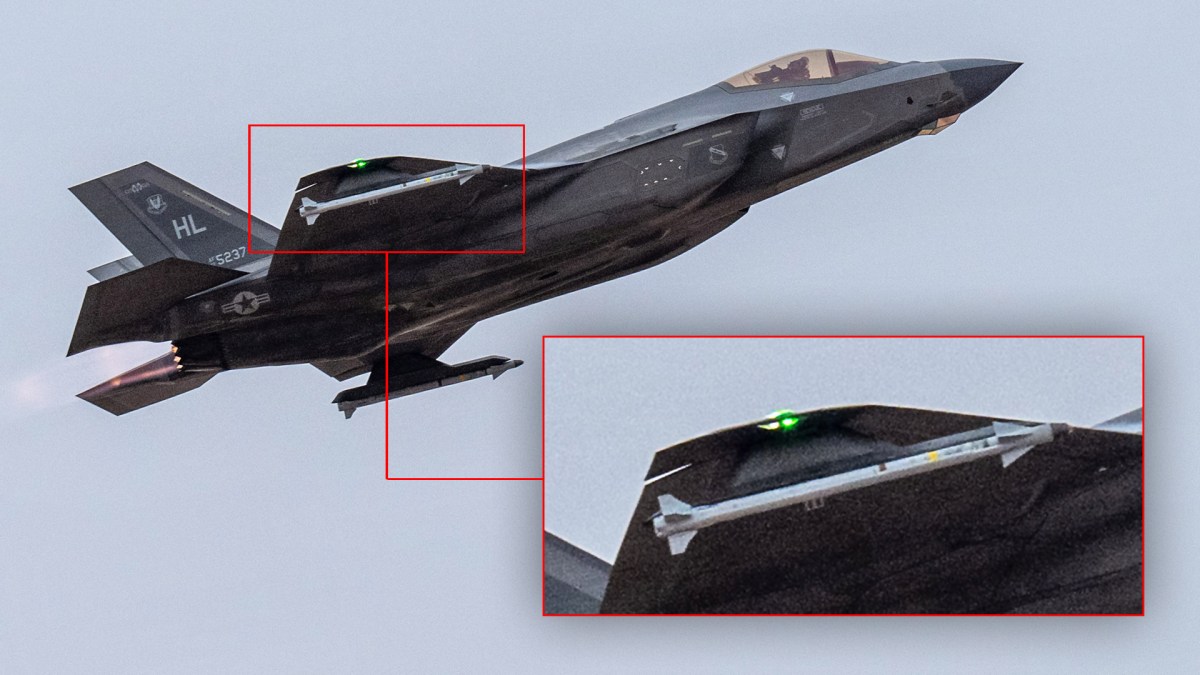
Tên lửa AIM-9X Sidewinders độc đáo lần đầu xuất hiện trên máy bay F-35A của Không quân Mỹ tại Trung Đông
Các tiêm kích F-35A Joint Strike Fighter của Không quân Mỹ tại Trung Đông đã bắt đầu mang theo tên lửa AIM-9X Sidewinders được sơn gần như hoàn toàn bằng màu trắng hoặc xám nhạt.
Nội dung chi tiết
U.S. Air Force F-35A Joint Strike Fighters in the Middle East have started carrying AIM-9X Sidewinders painted almost entirely white or light gray. This is a scheme that does not appear to have been previously seen on these missiles. This, in turn, could point to the emergence of a new version of the AIM-9X, and one specifically for the F-35 that might feature coatings to help reduce its radar cross section and/or other improved capabilities.
The Air Force has released pictures and video clips showing that its F-35As have been flying in the U.S. Central Command (CENTCOM) area of responsibility with the differently painted AIM-9Xs since at least November 3 . At the time of writing, missiles with this scheme do not appear to have been spotted on any other U.S. aircraft type in the region or on Air Force F-35As operating elsewhere globally.
Since the AIM-9X first began entering service in the early 2000s, the standard paint scheme has been a dark gray nose section attached to a light gray main body. The missile’s tail fins have been painted in the same color as ones at the nose end.
On the AIM-9Xs recently spotted in the Middle East, only the very tip of the nose, which contains the seeker, is still darkly colored. The rest of the body, as well as the fins, have a uniform lighter color. In some pictures, the missiles appear to be largely white rather than gray, but this could just be a trick of the light. The video immediately below offers a close-up look at one of the missiles with what looks to be a very light gray coloring. The footage also appears to deliberately blur out certain markings on the missiles.
The reason for the change in coloring is unknown. TWZ has reached out to the F-35 Joint Program Office (JPO) and Raytheon, the prime contractor for the AIM-9X, for more information.
The possibility has already been raised that what we are seeing is the newer Block II+ version of the AIM-9X, also known as the AIM-9X-3. The U.S. Navy, which is the lead service in charge of the Sidewinder program, has previously said this variant “incorporates specialized external materials to enhance aircraft platform survivability” and that it was specifically developed to “satisfy the requirements of the Joint Strike Fighter platform.”
The Block II+ version retained the improvements found on the preceding Block II AIM-9X-2 variant, which began entering service in 2015, including a lock-on-after-launch capability enabled by a new data-link. Compared to previous Sidewinder variants, the baseline AIM-9X had already been a major development, offering all-new high-off boresight targeting , thrust vectoring, and an advanced imaging infrared (IIR) seeker.
As TWZ has noted in the past , the AIM-9X-3’s “specialized external materials” could include new coatings and/or even structural changes to the baseline design to improve its stealthy characteristics. Developing a version of the AIM-9X with these features makes good sense in the context of the F-35. All versions of the Joint Strike Fighter are currently only able to carry AIM-9Xs externally under their wings, which negatively impacts the jet’s radar signature.
At the same time, the U.S. military ordered its first Block II+ AIM-9Xs in December 2017, and these missiles have been in inventory for years now . This raises the question of why we would only be seeing them in use now. New threat intelligence in the Middle East could have prompted the decision to use Block II+ rather than older AIM-9Xs. However, it has already been established that Iran , as well as the Houthi militants the regime in Tehran supports in Yemen , have air defense capabilities that can present risks to F-35s in certain circumstances .
Furthermore, in June, the Air Force released a picture of an F-35A flying in the Middle East carrying an AIM-9X with the standard paint scheme, but marked “F-35 USE ONLY.” This had also prompted discussions about whether the missile in question was a Block II+ version. At that time, TWZ had contacted the F-35 JPO to inquire about this marking and was directed to reach out to Warner Robins Air Force Base in Georgia instead.
A decision could have been made more recently to start painting Block II+ AIM-9Xs in a more distinctly different way compared to older versions for other reasons. Doing so could help make it easier for personnel on the ground to readily identify missiles intended for use only on F-35s. At the same time, this could indicate that the new paint scheme itself has no impact on signature. Though possible, this all seems unlikely due to known work done to provide new treatments to the missile to reduce vulnerability.
The paint job might also indicate a new variant or subvariant beyond the AIM-9X-3, including ones with further improved coatings of some kind applied. There are at least three other designated variants of the AIM-9X, though they all appear to still be in development.
The first of these is the System Improvement Plan III (SIP III) configuration, also known as the AIM-9X-4. This version includes hardware and software upgrades, including a new Application Specific Integrated Circuit (ASIC) processor.
“Integration of the ASIC processor into the AIM-9X-4 configuration has impacted missile reliability and halted testing,” according to an unclassified Modernized Selected Acquisition Report from the Pentagon , dated April 21, 2026. “Non-Ready-For-Issue (NRFI) AIM-9X-4 assets have negatively impacted Ao [operational availability] and Available Material (Am) rates. Recovery to the Ao requirement is anticipated to correlate to fielding of the AIM-9X-4 configuration in September 2027.”
There is also the AIM-9X-5, another SIP III version described as a direct companion to the -4 model, and the differences between the two are not immediately clear. Work is now underway on the further improved SIP IV configuration, or AIM-9X-6, as well.
A “Compact Variant,” or AIM-9X CV, is in development , but how much this missile will ultimately have in common with existing variants remains to be seen. Navy budget documents have described it as having a new “compact airframe optimized for internal carriage on advanced aircraft with improved kinematic performance.”
The long-term roadmap for the AIM-9X had previously included a more substantially evolved Block III version, which could have featured extended range and improved kinematic performance by using a new highly loaded grain rocket motor. The Block III plan was shelved, at least publicly, years ago, but the Navy has continued to invest heavily in this kind of rocket technology.
AIM-9Xs with new paint schemes might also reflect missiles in a subvariant configuration that has not received a separate designation. Such a version could have been developed in response to pressing needs in the Middle East, specifically, including optimization against particular target sets like longer-range one-way-attack drones. The Foreign Policy Research Institute (FPRI) think tank published a report last year saying that the Israeli Air Force (IAF) had modified older AIM-9M Sidewinders to be more effective against drones.
“It isn’t clear what was modified, and if it was hardware or software based, or both, to increase its effectiveness against smaller, slower-flying targets, especially at lower altitudes, where various kinds of ‘clutter’ on the surface below can hamper detection and tracking. “Seeker” here could also be shorthand for a broader set of modifications to the Israeli AIM-9Ms. As something of a tangential example, years ago, the U.S. Army added new proximity fuzes featuring small conformal radar antennas to existing FIM-92 Stinger short-range, heat-seeking surface-to-air missiles to improve their effectiveness against various targets, and particularly drones.”