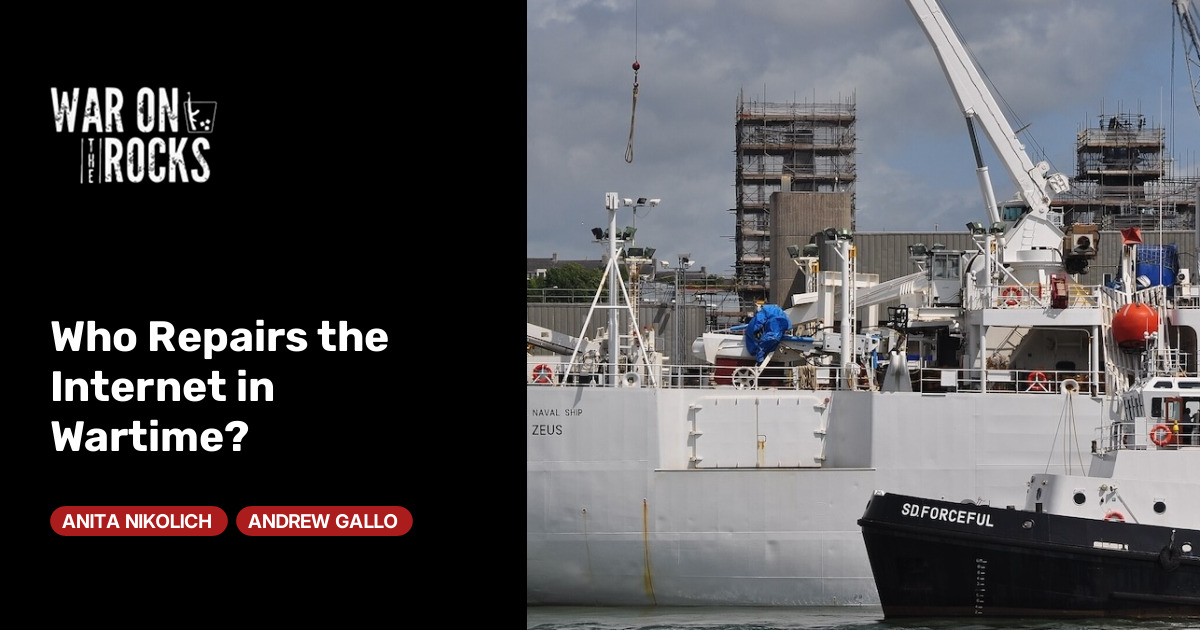
Who Repairs the Internet in Wartime?
In spring 2026, Britain, Norway, and the United States tracked and disrupted a covert Arctic exercise off the coast of Norway involving Russian deep-sea submersibles simulating the deployment of a weapon designed to disable the two 1,400-kilometer submarine cables linking the islands of Svalbard to mainland Norway. Svalbard hosts a satellite ground station serving Europe, the United States, and Japan. This encounter revealed that NATO allies can detect a covert subsea operation and, if caught in time, disrupt it. Had it been a real attack, the first question would have been where and how quickly internet and sensitive government traffic could be rerouted. But this requires grappling with who will repair the cables, how quickly, and what would happen if additional cables in other theaters were cut before the first repair was complete. To effectively disrupt global communications, an adversary needs only to damage cables in multiple locations faster than the repair system can restore them. New cable routes being developed to avoid geopolitical choke points face additional restoration challenges. Nordic research networks are planning a 10,000-kilometer Polar Connect cable from Sweden across the Arctic Ocean to Japan and North America, a route intended to provide an alternative path to the Red Sea. Its planned route runs close to Svalbard. The route will pass through the same waters where Russia recently rehearsed disrupting cables. In 2017, Adm. (ret.) James Stavridis warned in the foreword to a Policy Exchange report by future U.K. Prime Minister Rishi Sunak, “It is not satellites in the sky, but pipes on the ocean floor that form the backbone of the world’s economy. ... We have allowed this vital infrastructure to grow increasingly vulnerable and this should worry us all.” Since 2020, the Federal Communications Commission has implemented strong policies around submarine cable ownership and supplier screening. But the United States has no wartime repair and restoration strategy for a campaign of simultaneous cable failures across multiple theaters. Wartime submarine cable repair should be treated as a national security mission and funded as such. The designation of submarine cables as critical infrastructure, the establishment of a federal coordinating authority with emergency powers to prioritize repairs, and an increased budget to expand the Cable Security Fleet would give the United States a way to decide which cables are repaired first and which ships are needed to carry out those decisions. BECOME A MEMBER Vulnerability in the Repair Queue Cable faults are routine. Fishing gear, anchors, and other accidents damage submarine cables roughly 150 to 200 times annually, a number easily handled by the approximately 22 ships in the world equipped to repair subsea cables. Under normal conditions, this system works well; while one cable is under repair, operators reroute traffic over spare capacity on other paths. But several faults at once can exhaust that spare capacity and clog the queue for repair ships. The Hunga Tonga–Hunga Ha’apai eruption of 2022 caused an underwater landslide that isolated the island nation of Tonga for five weeks, with full restoration taking almost 18 months . And in February 2023, five of Vietnam’s international cables were damaged within a short time frame , with full restoration happening nine months later. Repair capability also depends on several factors: access: ship location, its flag, who legally controls it, a trained crew, whether it can be insured in a conflict zone, and the availability of spare cable and parts. The Pacific illustrates the risk. Repairs there are coordinated through the Yokohama Zone maintenance agreement, which relies on three operators, including S.B. Submarine Systems, a Shanghai-based cable installation and maintenance company that is majority owned by China Communications Services, whose controlling shareholder is state-owned China Telecommunications Corporation. It has repaired cables owned by Google and Meta. U.S. officials have raised security concerns about American dependence on Chinese repair vessels. In a conflict involving China or Taiwan, the United States could not safely assume continued access to Chinese-controlled repair capacity. Beijing would not need to sabotage anything. It could simply decline to sail and repair. The United States doesn’t have a government-operated repair ship, since the Navy cable ship Zeus was officially deactivated in 2025 after four decades of service. Instead, the Cable Security Fleet is authorized at $10 million annually for payments to the operator of two privately owned ships to make them available to the Department of Defense when requested. This provides a minimum assured capability for repairing an isolated failure but does little for simultaneous cuts across multiple theaters. A contract with two ships is not the same as having two ships immediately available to sail. Since they operate commercially, these ships can be contracted to work far from their assigned ocean. For example, in 2022, the cable ship Dependable spent a month in the Indian Ocean laying a cable to the Naval Support Facility in Diego Garcia , far from its coverage area of the Pacific. Less discussed is the criticality of the subsea cable supply chain. A repair ship is only as useful as the spares it carries: jointing kits, repeaters, and cable that matches the system being repaired. These components are not interchangeable and not always readily available. Most of Tonga’s 18-month wait went to confirming specifications, then manufacturing and shipping the right replacement cable from France. U.S. policy is also narrowing the supplier pool. In 2025, the Federal Communications Commission barred equipment on its Covered List of national security risks from U.S.-connected cable systems, and the Commission’s Third Report and Order banned devices containing Covered List components. A wartime restoration strategy therefore requires stockpiling trusted spares before they are needed. Europe has begun addressing this problem. In 2026, the European Union allocated €60 million (or about $70 million — € 20 million for the Baltics, €40 million for the Mediterranean and Atlantic) for modular cable repair equipment to be pre-positioned at ports and shipyards. These can be rapidly installed on vessels pre-configured to receive the module. The United States has no equivalent. Repair Under Fire In armed conflict, a vessel or cable can become a lawful military objective if the targeting criteria are met. The Second Geneva Convention protects hospital ships but says nothing about cable ships , whose legal and operational risk can change depending on how they are used during hostilities. The 2025 Newport Manual on the Law of Naval Warfare treats military communications cables as military objectives. However, in practice, it is difficult to distinguish military communications cables from commercial ones because military and government communications often travel over commercial cable systems. In a 1923 arbitration , Cuba Submarine Telegraph Company (Great Britain) v. United States, a tribunal rejected a British company’s claim for cables the U.S. Navy cut in Cuban waters during the Spanish-American War, finding the company functioned as a Spanish public service. The same logic could apply today to a commercial cable that carries military traffic. Cable repair ships are essential to restoring both military and civilian communications but could become military targets because they have no immunity from attack. As Douglas Burnett, former legal adviser to the International Cable Protection Committee, has argued, cables and repair ships remain legitimate targets in a conflict. Insurance compounds the problem, because war coverage can be canceled on as little as 72 hours’ notice. After U.S. hostilities with Iran began on Feb.