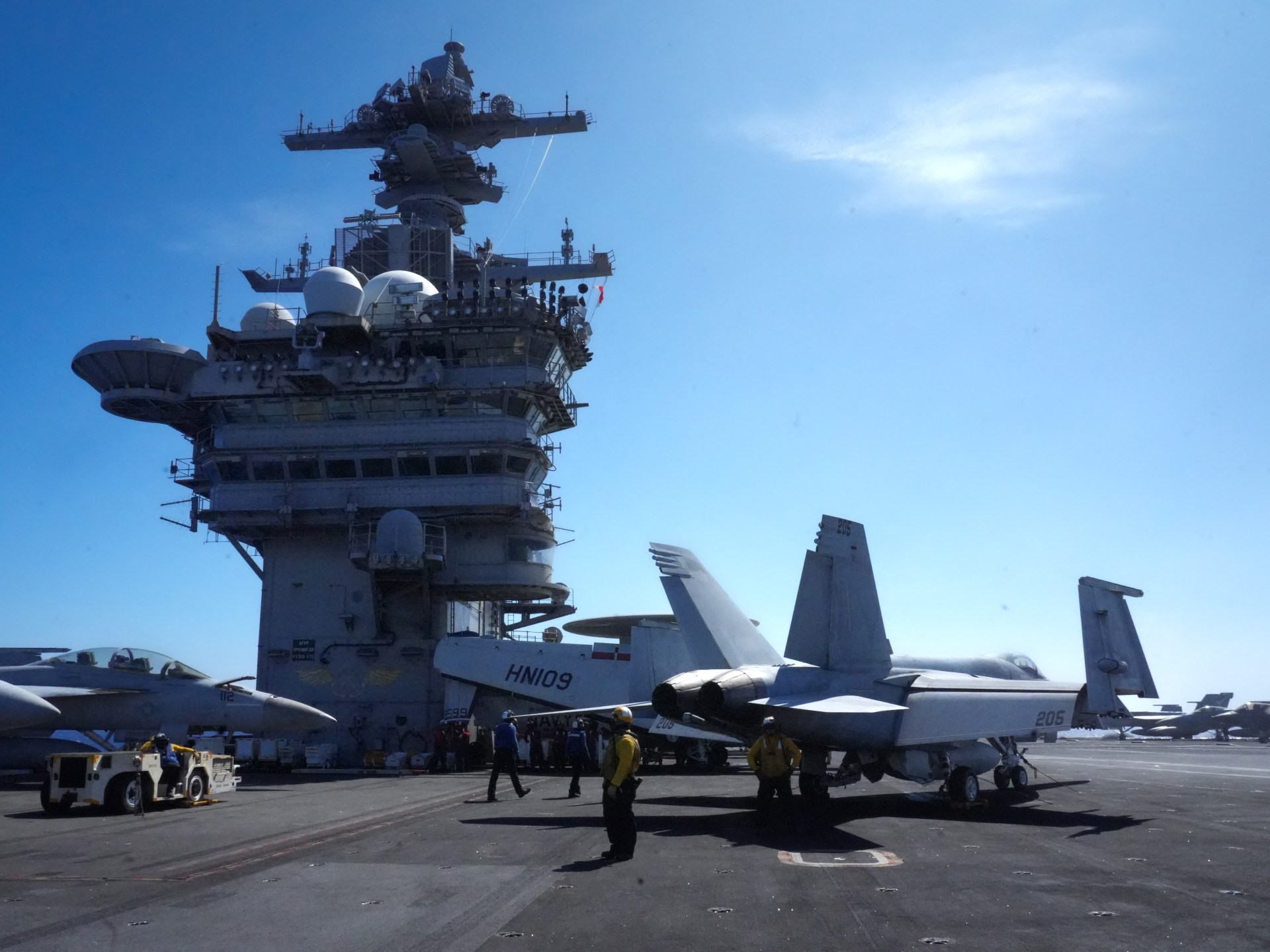
Tàu sân bay USS Roosevelt đến Trung Đông: Chiến tranh Mỹ-Iran sắp bùng phát trở lại?
Hoa Kỳ đã triển khai tàu sân bay thứ ba tới Trung Đông trong bối cảnh các nỗ lực ngoại giao nhằm chấm dứt vĩnh viễn cuộc chiến Mỹ-Israel với Iran và mở lại eo biển Hormuz vẫn đang bị đình trệ.
Nội dung chi tiết
The United States has deployed a third aircraft carrier to the Middle East as diplomatic efforts to permanently stop the US-Israel war on Iran and reopen the Strait of Hormuz remain stalled.
The aircraft carrier joins two others operating in the US Central Command (CENTCOM) area of responsibility.
The United States and Iran entered into a two-week ceasefire in April and later announced a broader memorandum of understanding in June, which collapsed in early July.
Since then, mediators from Pakistan and Qatar have been trying to prevent a return to the full-scale exchange of attacks between the US and Iran that also badly affected the broader Gulf region in March.
Last week, US President Donald Trump stated that further military strikes against Iran are “quite unlikely” and said the military component of the war was “effectively over” following discussions with Qatar’s Prime Minister Sheikh Mohammed bin Abdulrahman bin Jassim Al Thani. But he noted the US military remains “locked and loaded” if conditions change.
Does the deployment of another aircraft carrier to the region mean the US-Israel war on Iran is going to resume?
Named after the 26th US president, Theodore Roosevelt, the vessel is a nuclear-powered aircraft carrier.
Commissioned by the US Navy in 1986, the ship carries more than 5,000 personnel and a full air wing of more than 60 aircraft, including F-18s, the twin-engine, supersonic, all-weather multirole fighter planes.
According to the US Navy, the warship is tasked with “conducting carrier air warfare operations and assisting in the planning, control, coordination and integration of air wing squadrons in support of carrier air warfare”.
Besides combat operations, the carrier also replenishes ships at sea and rescues people, including refugees, at sea.
The USS Theodore Roosevelt has performed combat and humanitarian missions since its commissioning. During the 1990-91 Gulf War, it was deployed to the Mediterranean and the Red Sea for combat operations. In 2003, it also supported US strikes during the Iraq War.
It was also deployed in the Asia Pacific region during 2020-21 for military exercises with India, Japan, Australia, South Korea and Malaysia.
According to another official, it arrived in the Middle East on November 15.
But the Pentagon and CENTCOM, which oversees military operations in the Middle East, have not formally confirmed the carrier’s arrival in the region.
The arrival of the USS Theodore Roosevelt in the Middle East brings the total number of US aircraft carrier strike groups operating in the region to three. The USS George Washington and the USS George HW Bush are the other two aircraft carriers currently deployed in the region.
However, the US military is yet to confirm these deployments.
The US has had troops and military assets stationed at bases in the Middle East for decades. Of these, eight are permanent bases, located in Bahrain, Egypt, Iraq, Jordan, Kuwait, Qatar, Saudi Arabia and the United Arab Emirates. As of mid-2025, there were 40,000 to 50,000 US soldiers stationed in and around the Middle East, including personnel at large, permanent bases and smaller forward sites across the region.
According to open-source intelligence analysts and military flight-tracking data, the US has deployed more than 120 aircraft to the region since early February, before the war on Iran began. This is the biggest surge in US airpower in the Middle East since the Iraq War.
Reported deployments include E-3 Sentry Airborne Warning and Control System (AWACS) aircraft, F-35 stealth strike fighters and F-22 air superiority jets alongside F-15s and F-16s. In March, the Pentagon also ordered additional US forces to the Gulf.
The reinforcements consisted of three distinct formations.
The first was the Tripoli ARG, centred around the America-class assault ship USS Tripoli and the 31st Marine Expeditionary Unit (MEU).
The second was the Boxer ARG, built around the Wasp-class assault ship USS Boxer and the 11th MEU, based in southern California in the US.
Together, these two Marine groups have added 4,500 Marines and sailors in the region.
The third was a contingent of about 2,000 soldiers from the 82nd Airborne Division’s Immediate Response Force, based at Fort Bragg, North Carolina. The airborne infantry division is focused on parachute assaults.
In total, nearly 7,000 additional soldiers have already been deployed to the Middle East since the US-Israel war on Iran began.
Kazem Gharibabadi, Iran’s deputy foreign minister for legal and international affairs, has said the country “will not wait for the US to attack first”. He said, “The US may be seeking to buy time by abusing diplomacy, in order to prepare the ground for another attack.”
Speaking to state TV in a video released by Iran’s Fars news agency, Gharibabadi warned, “Iran is not Cuba that you can blockade, nor is it Venezuela that you can force to surrender.”
He said US forces “have had no success with either an air blockade or a land blockade” in Iran so far, while the Islamic Revolutionary Guard Corps (IRGC) is currently producing missiles with “new ranges”.
Iran’s Foreign Minister Abbas Araghchi has called for stronger regional energy cooperation, warning US attacks threaten stability across the Middle East.
“Given the increasing impact of US and Israeli aggression on the region’s energy security, strengthening energy cooperation has become an urgent and strategic necessity,” Araghchi said at a meeting of foreign ministers of the Economic Cooperation Organization in Islamabad, Pakistan, on Monday.
“Our region needs not only an independent security framework but also a regional, reliable and sustainable energy mechanism to safeguard energy flows, ensure stable energy supplies, reduce vulnerabilities from external factors, and increase our collective resilience to geopolitical shocks and disruptions,” the IRNA news agency quoted him as saying.
The Trump administration has appeared increasingly divided on how to proceed with Iran, since the Republican Party suffered heavy losses in this month’s US midterm elections.
Secretary of State Marco Rubio has said Washington’s economic pressure campaign against Iran was proving effective, so a resumption of large-scale military operations was likely unnecessary. “The economic pressure on Iran is going to get even worse,” he added.
But Trump has given mixed messages about his plans for the war.
Still, Trump insisted that the US economic pressure campaign against Iran would stay in place, including a naval blockade in the Strait of Hormuz and a more recent task force aimed at cutting off Iran’s trade by land and through the Caspian Sea.
Meanwhile, Iran’s conditions to end the war include an end to the US naval blockade of Iran’s ports, the lifting of economic sanctions, the release of Iranian frozen funds, ending fighting on all fronts and an explicit announcement of an end to the war.