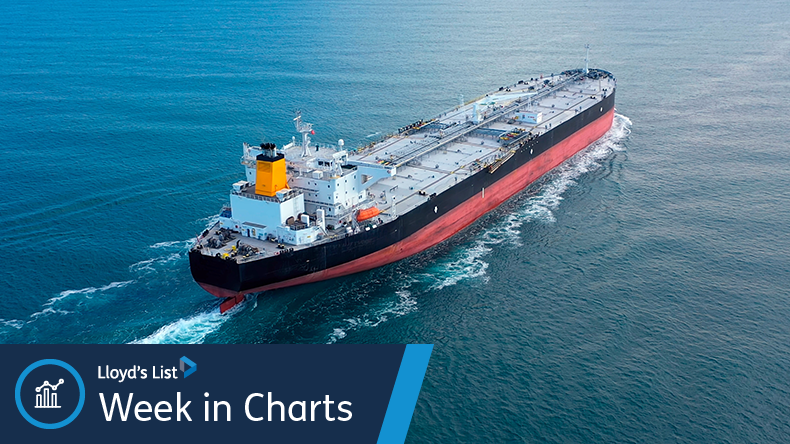
Biểu đồ trong tuần: Nhập khẩu dầu thô Trung Quốc từ Vùng Vịnh Trung Đông tăng cùng với số lượng tàu chở dầu qua eo biển Hormuz | Lưu lượng tàu qua eo biển Hormuz đạt mức cao nhất thời chiến khi các cuộc tấn công gia tăng
Chuyên mục tổng hợp dữ liệu và số liệu hàng tuần của Lloyd’s List đằng sau các bản tin, phân tích và thông tin thị trường của chúng tôi
Nội dung chi tiết
Lloyd’s List’s weekly showing of the data and figures behind our news, analysis and markets coverage
CRUDE oil imports from the Middle East Gulf into China rose in October and are poised for further gains this month as Hormuz tanker transits improve despite the rise in attacks in October, wrote senior reporter Matthew Rajendra .
Lloyd’s List Intelligence ’s Maritime Intelligence Unit data showed tanker transits reaching a crisis-era high in October, with 174 crude oil tankers transiting the Strait of Hormuz despite the number of attacks being the highest, with 37 confirmed.
Eleven very large crude carriers were damaged as of October 23. Non-Iran-linked tankers continued to dominate transits through the strait despite the peak in attacks.
Hormuz tanker traffic hits wartime high as attacks surge
Non-Iran-linked tanker traffic through the Strait of Hormuz reached its highest level of the war in October, even as attacks on merchant shipping surged to a record monthly high, underscoring how commercial adaptation is increasing exposure rather than signalling a return to normality, reported editor-in-chief Richard Meade .
Tanker traffic through the Strait of Hormuz is recovering rapidly, but so too is the violence confronting ships prepared to make the passage.
Lloyd’s List Intelligence data shows 449 tanker transits through Hormuz in October, up from 413 in September and 323 in August. Crucially, 418 involved vessels with no identified Iranian link, the highest monthly total since the war began on February 28 and up from 385 in September.
Middle East Gulf bulker traffic hits conflict-era high as China-linked ships step up
Middle East Gulf bulker traffic rose to its highest level since the conflict began in October, with a record 45 bulk carriers entering the region despite the deteriorating security environment, wrote senior reporter Ece Göksedef .
A total of 84 bulk carriers transited the Strait of Hormuz in October, the highest monthly figure since the conflict began outside the brief Memorandum of Understanding period, when traffic surged as ships exited the MEG en masse.
Arctic transits nearly double in October as Russia eyes ‘maritime Trans-Siberian Railway’
Transits via Arctic shipping routes nearly doubled in October 2026 compared to the same period last year, as Russian and Chinese dominance of the region continues, wrote senior reporter Joshua Minchin .
Data gathered by Lloyd’s List Intelligence’s Maritime Intelligence Unit shows that 109 cargo-carrying vessels over 10,000 dwt transited either the Northern Sea Route or via the Kara Sea (further north) last month, compared to just 65 in October 2025. In September 2026, that figure was 133 vessels, versus 84 in September 2025.
Those transits were made by primarily by vessels with either Russian or Chinese ownership, as the two nations continue to set the pace in the region.
Ship recycling stays weak in October while sanctioned vessel disposals accelerate
Ship recycling volumes remained in the doldrums in October, although the number of vessels arriving at key recycling centres edged higher from September, reported markets editor Rob Willmington .
Tankers and bulk carriers accounted for the largest share, with seven vessels from each sector arriving at recycling yards.
Among them was the 1995-built, 43,700 dwt handysize bulker Enisey ( IMO: 9079169 ), which is being recycled at Alang , India. The Russia-flagged vessel is on the US Office of Foreign Assets Control sanctions list because of its links to sanctioned Russian owner TK Nord Project .
Please Note: You can also Click below Link for Ask the Analyst Ask The Analyst
Your question has been successfully sent to the email address below and we will get back as soon as possible.
All set!
All fields are required. For multiple recipients, separate email addresses with a semicolon.
Please Note: Only individuals with an active subscription will be able to access the full article. All other readers will be directed to the abstract and would need to subscribe.