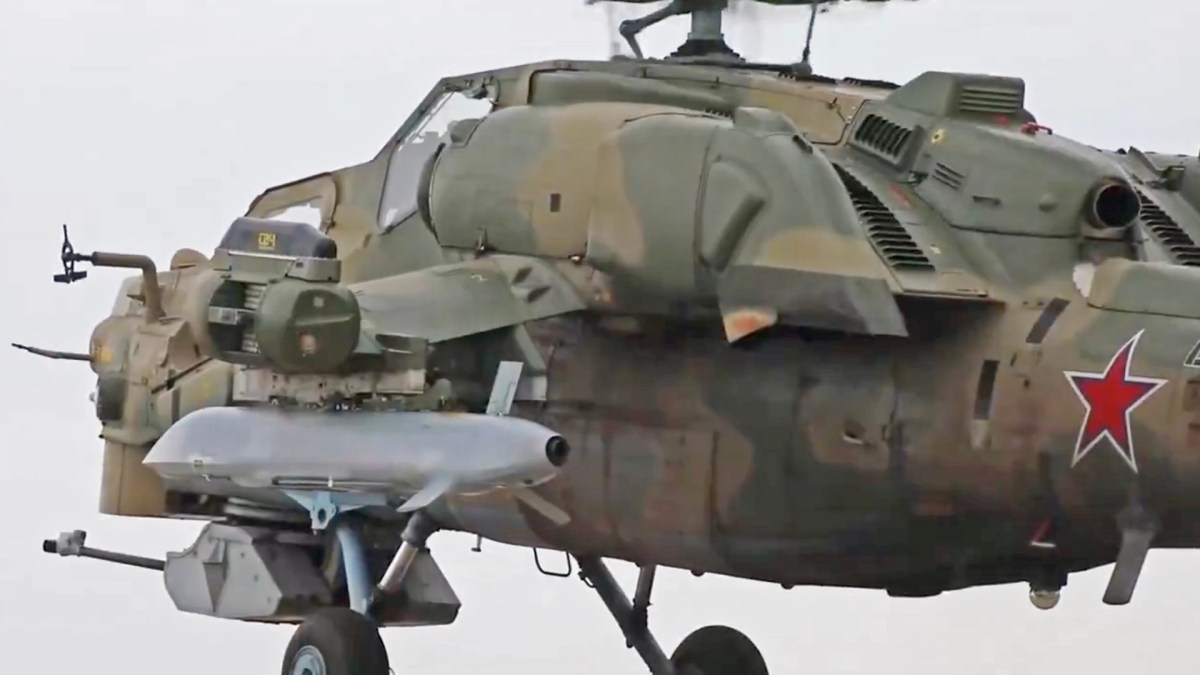
Russian Mi-28 Attack Helicopters Are Now Firing Cruise Missiles
Russia’s Defense Ministry has released footage showing a Mi-28NM Havoc attack helicopter firing a small, low-cost cruise missile, supposedly during combat operations in Ukraine. The video provides the clearest official indication yet that Russia is exploring a non-traditional, new launch platform for its emerging family of relatively inexpensive standoff weapons.
Nội dung chi tiết
One missile is seen being fired from a pylon beneath the helicopter’s left-side stub wing; the helicopter returns after the mission with an unfired missile still hanging under the right-side stub wing. The Defense Ministry has not provided a date, precise location, or details about the target. Nor has it identified the weapon, which could be either the S8000 Banderol or the Dan-T , two closely related and visually very similar Russian missile developments.
The footage is not entirely unexpected. Earlier this year, photographs began circulating showing a Mi-28NM on the ground, carrying what appeared to be the same missile. There had also been unconfirmed reports from Ukraine in August that Russia was using the helicopter as a launch platform for Banderol, including firing the weapons from over the Sea of Azov against targets around Odesa.
The Banderol, developed by Russia’s Kronstadt company, was first detailed by Ukrainian military intelligence (GUR) in the spring of 2025 . According to GUR, the missile is approximately 16.4 feet long, has pop-out wings, and is powered by a small turbojet engine. It reportedly flies at around 310 miles per hour, has a range of up to 310 miles, and carries a warhead weighing approximately 110 pounds.
GUR’s analysis also provided a detailed rundown of the foreign components it identified in the weapon. Its production involves “around 30 companies” supplying “more than 20 key components,” with potentially additional parts that have yet to be identified. Among the components reportedly used are a small commercial Chinese SW800Pro turbojet and a Russian-made Kometa digital antenna for satellite navigation. The weapon also makes extensive use of components sourced from foreign manufacturers , including in the United States.
The other possible candidate is the Dan-T, apparently derived from the Dan-M target drone, but with a roughly 300-pound warhead added. It is also reported to have a range of around 310 miles, while costing approximately 35 percent less than the Banderol.
The Banderol first emerged publicly through Ukrainian intelligence reporting, but Moscow eventually began acknowledging the weapon. Russian state television showed it beneath the wing of a Kronstadt Orion drone in July 2026, when it was first officially presented , albeit heavily obscured.
Ukrainian reporting indicates that the weapon has already seen operational use. Between mid-May and mid-July, the Ukrainian Air Force recorded 16 strikes involving Banderol. It reported five launches in a single barrage on July 16.
There are also indications that the Dan-T could ultimately become the more widely procured weapon. Reports from Ukraine suggest that Russia’s Aerospace Forces may have decided to focus procurement on the Dan-T, with plans to acquire tens of thousands of the missiles . Unlike the Banderol, the Dan-T is also reportedly intended for launch from combat aircraft and ground-based launchers. In September, Russia was already pitching the weapon for export at the El Alamein International Airshow in Egypt.
The use of a helicopter to launch a weapon of this type is particularly unusual. A relatively slow- and low-flying platform like the Mi-28 would be much more vulnerable to enemy air defenses than a fixed-wing tactical aircraft. However, the reported range of the Banderol and Dan-T would allow the helicopter to launch well away from the intended target, potentially from across the border while remaining in Russian airspace. For comparison, the maximum range of the Kh-38 (or LMUR) missile — which is otherwise the farthest-reaching Mi-28 weapon — is a little over nine miles.
For many months now, Russia has been seeking to expand its arsenal of weapons capable of striking Ukrainian targets from standoff distances. Mounting losses of Russian tactical aircraft to Ukrainian ground-based air defenses have underscored the need for weapons that can hit targets precisely at and well behind the front lines without exposing expensive aircraft to excessive risk.
Most notably, Russia has fielded the UMPK , a fairly crude type of guided glide bomb that has caused considerable difficulties for Ukrainian air defenses since its introduction around early 2023. The UMPK series has since been followed by more refined winged precision-guided glide bombs.
However, these weapons are unpowered. The small turbojet engine fitted to the Banderol and Dan-T puts them in the cruise missile category, while their reported range of up to 310 miles is particularly significant, if accurate. That range comes at the expense of warhead size, especially when compared with larger Russian cruise missiles.
The weapons’ navigation and electronic warfare protection systems are also important considerations. An inertial navigation system, combined with a jamming-resistant satellite navigation system, should provide a degree of resilience against the kind of electronic warfare jamming that is increasingly being employed by Ukraine . Satellite navigation can also help correct for accumulated drift, an important consideration given the accuracy limitations of inertial navigation systems over longer distances.
In essence, the Banderol and Dan-T offer Russia a lower-cost, potentially higher-volume complement to its more sophisticated cruise missiles .
“The Banderol is particularly relevant in the context of the economics of the Ukraine conflict. Russian forces have increasingly used combinations of relatively inexpensive one-way attack drones and more expensive cruise and ballistic missiles. The drones can be produced in large numbers and used to complicate air-defense operations, while the more capable missiles provide greater speed, range, payload, or penetration capability. A small turbojet-powered weapon such as Banderol offers another point on that spectrum.”
The ability to launch these weapons from non-traditional platforms, including drones, attack helicopters, and potentially ground-based systems, would also give Russia greater flexibility in how it employs them. Its bomber fleets and fixed-wing tactical aircraft could concentrate on their primary roles and make use of their established weapons, while other platforms take on some of the standoff strike mission.
For the Mi-28NM , meanwhile, the ability to employ a long-range cruise missile could provide a useful additional role, particularly after the helicopter fleet has suffered heavy losses during the war in Ukraine.
According to the Oryx open-source tracking group , Russia has lost 21 Mi-28s since launching its full-scale invasion of Ukraine four years ago. This figure could be higher because Oryx only tabulates losses it can confirm visually. Russia began the conflict with a force of around 110 Mi-28s of all versions. Other Russian battlefield helicopter types have suffered even heavier attrition, reflecting the level of danger that rotorcraft are exposed to when close to the front lines.